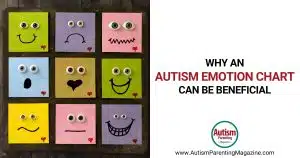

Many tools can help teach autistic children about their own emotions. One great tool is an autism emotion chart. These charts contain pictures and can be as interactive as the parent or teacher makes them.
Emotional regulation can start with the child being able to understand and identify what emotion they may be feeling. If a child is nonverbal or has limited communication, using a visual emotions chart can make it easier for the child to communicate.
What is an autism emotion chart?
These charts can have different parts to them depending on what the autistic child needs and the person creating the chart. Most of the time, they have different people with different facial expressions that the child can point to when choosing an emotion they may be feeling.
Autistic children can have a difficult time with emotional awareness. Different visual supports can help build and strengthen these skills. There are quite a few free resources online that provide examples or even have premade emotion charts that parents and teachers can print.
For example, a parent or teacher could search Pinterest for visual aids for feelings or feelings charts. Then, they can browse different examples and free resources until they find what they are looking for.
What should an emotion chart for autism include?
There are many different types of charts. They can vary depending on the child and the parents or teachers who are looking for visual support.
There are interactive charts that practitioners can print, laminate, or print on sturdy paper. They can attach Velcro to different pieces, allowing a child to easily remove and place the piece that represents their current emotion.
Some charts can be a part of the morning time routine that has students identify what they are feeling through emojis or pictures of different people expressing emotions. There can also be a feelings rating scale that can go from (1), which is not good, to (5), which is great.
These charts and tools can help autistic children start to identify emotions in a healthy way and develop more self-awareness and understanding. A feelings chart is a great first step that can help teach children ways of expressing themselves and their emotions healthily.

Why are identifying emotions beneficial for children?
As a parent of a child diagnosed with autism, I can say that interactive feelings charts and emotional regulation games, such as the Ungame, are an amazing and fun start to teaching different emotions. Once children learn the words for what they are feeling and what those words mean, it empowers them to take control of their emotions.
Charts and games can also be great tools for parents and teachers to learn different ways of approaching and talking about emotions and how they can feel. Numerous picture books have different faces expressing a wide variety of emotions and can provide parents with opportunities to talk about what the person may be feeling and why.
I used numerous books and feelings charts to talk to my children about many different emotions. Tools and resources are available for every age and stage. Resources for toddlers may not appeal to teenagers, and visual support for a teenager may be too complicated for a toddler.
Parents know their children the best
Overall, parents know their children best and what they enjoy. I have made feelings charts with funny emojis and Pokemon.
There are many ways to create charts that help support and strengthen emotional development and regulation. The Internet has many different websites that provide examples and premade charts.
There are free resources and those that parents and teachers can pay for to personalize the chart to their child. There are endless possibilities and a chart for every character, hobby, or anything a child may enjoy.

FAQs
Q: What categories or emotions are typically included in an autism emotion chart?
A: Autism emotion charts commonly include a spectrum of basic emotions such as happiness, sadness, anger, fear, and surprise. Some charts may expand to include more nuanced emotions, allowing for a comprehensive representation of the individual’s emotional experiences.
Q: How do you introduce autism emotion charts?
A: To introduce emotion charts, start by explaining their purpose in a clear and positive manner. Gradually incorporate the chart into daily routines, encouraging individuals to use it by showing how to identify and communicate various emotions.
Q: How do autistic people show their emotions?
A: Some autistic individuals show emotions directly with words, while others might show them through actions like gifts or helpful deeds. They might not always use facial expressions like everyone else, but their feelings are genuine.
Q: Can autistic adults feel love?
A: There’s no scientific evidence suggesting autistic adults lack the capacity for love. Studies indicate they experience and express love similarly to neurotypical individuals, though communication differences may impact their perceived expression.