

When your child is diagnosed with autism, it can feel very lonely. But knowing the latest autism statistics can make you feel less isolated. You will soon realize you are part of a much bigger autism community.
The latest research in 2023 from the CDC shows that one in 36 children is now diagnosed with autism. This is an increase from one in 44 children two years ago. Since the report was recently released, the data is likely to stay the same through 2024.
We here at Autism Parenting Magazine recognize that you are busy and have scoured the latest research, CDC reports, and even our exclusive data collected from surveys sent out to more than 160 000 of our email subscribers.
Breaking down autism prevalence stats…

From 4-5 in every 10,000 in the 70s to half of all kids in 2025
Will half of US kids have autism by 2025? This prediction made by Dr. Stephanie Seneff, Research Scientist from the Massachusetts Institute of Technology (MIT), may be scoffed at by some, but the latest CDC statistics do indicate rising prevalence rates:

- 1 in 36 (or 2.8%) of children in the US were identified with ASD using estimates from CDC’s Autism and Developmental Disabilities Monitoring (ADDM) Network
- These stats were based on eight-year-olds living in 11 ADDM Network sites in the United States
- The 2023 prevalence estimate from data collected in 2020 is roughly 317% higher than estimates from 2000
- The last estimate, reported in 2021, showed 1 in 44 kids identified with ASD. A mere two years later, the reported estimate increased to 1 in 36
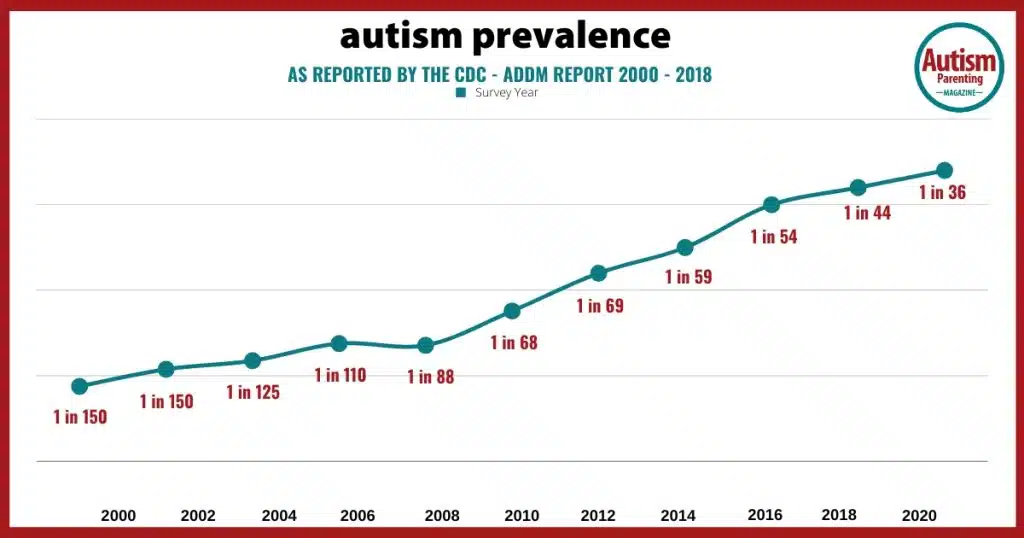
Below is a break-down of the prevalence rates per year since 2000:

Profound autism
In the latest data released, the CDC reported on the prevalence of profound autism for the very first time. Overall, it showed that 26.7% of people with autism spectrum disorder have profound autism.
The study also indicated that more than a quarter of autistic 8-year-olds have profound autism, and the prevalence of profound autism in black children is 76% higher.

Gender, race, and socioeconomic factors
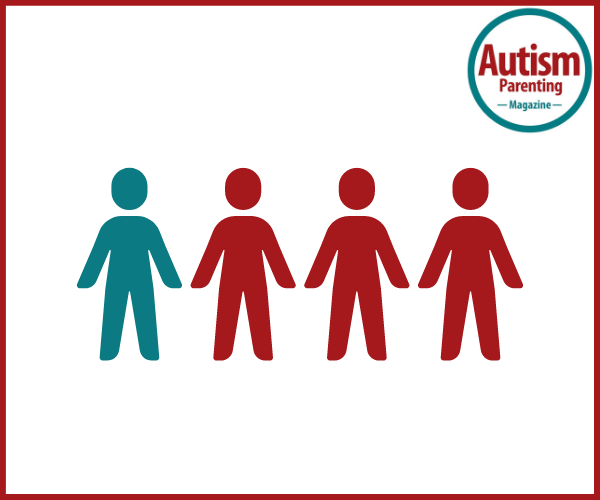
- CDC data estimates a male-to-female ratio of 4:1 in autism, but other research suggests a ratio closer to 3:1. A recent systematic review, however, confirmed the CDC data.
- Autism Parenting Magazine’s exclusive data reveals close to 6% of autistic children have some form of gender dysphoria
- Autism occurs in all socioeconomic groups. In contrast to previous years’ ADDM data, socioeconomic status (as measured by neighborhood-level mean household income) was not consistently associated with autism prevalence
- Overall, ASD prevalence, according to the latest data, was lower among non-Hispanic White children (24.3) and children of two or more races (22.9) than among non-Hispanic Black or African American (Black), Hispanic, and non-Hispanic Asian or Pacific Islander (A/PI) children (29.3, 31.6, and 33.4 respectively).
- A recent study confirmed these disparities in that, compared with non-Hispanic White children, ASD prevalence was 1.8 times as high among Hispanic, 1.6 times as high among non-Hispanic Black children.

Prevalence Difference: From California to Maryland
- Research suggests autism rates vary greatly across countries—and even among states in the US—cultural and methodological factors are probably behind these differences.
- CDC data shows that California has the highest percentage of 8-year-old children identified with ASD by ADDM Network Sites. The differences in states vary from 2.3% or 1 in 43 children in Maryland to 4.5% or 1 in 22 children in California.

- Examples include: California at 3.9%, Missouri at 1.7%, South Korea at 2.84%, France at 0.36%, and Qatar at 1.14%

- Many developing countries do not have reliable autism statistics due to a lack of resources. This means most autism research is from affluent, English-speaking countries.
- According to the World Health Organization (WHO), 1 in every 100 children has autism.

Autism prevalence rates in adults
- Many parents discover their own neurodivergence when seeking a diagnosis for their child
- An estimated 2.2% of adults in the US are autistic, according to a CDC report
- Consistent with estimates of ASD in children, California has the greatest (estimated) number of adults with ASD in the states surveyed in the US
- Prevalence is higher in men than women
- These adult statistics highlight the fact that autism is a lifelong neurodevelopmental condition

Do areas with higher prevalence rates have parents who are better educated and more aware of autism? Alternatively, are these areas, with higher prevalence rates, more accepting of neurodivergence, creating an environment where seeking diagnosis and intervention is easier with less stigma? We need more research but autism prevalence does seem to be influenced by the following:
- Autism education, awareness, and acceptance
- Better diagnostic practices
- Changes in diagnostic criteria
Causes and risk factors
- Autism has a strong genetic component as demonstrated by twin studies
- A child has an approximately 19% higher risk of autism if an older sibling is on the spectrum
- A growing body of evidence investigating maternal infection, drug use, and age (there is also evidence linking advanced paternal age to an increased risk) as potential causes of autism
- Health complications during pregnancy and in childbirth may raise a child’s autism risk significantly, a baby experiencing complications both during and before birth may have a 44% increased risk of autism
- Toxins in the environment, especially heavy metals like mercury and lead, have also been associated with an increased risk, but most of these studies have various methodological limitations
Treatment, intervention, and support

At Autism Parenting Magazine we have access to exclusive data gathered from our database of readers:
- While FDA-approved medication for treating irritability in autism is limited to risperidone and aripiprazole, caregivers are increasingly turning to complementary and alternative medication
- Parents, who give their autistic child CBD products, do so mainly to treat anxiety (42.9%) and challenging behavior (36.9%)
- Of the respondents giving CBD to those in their care, 31.3% started using the product during the COVID-19 pandemic

- ABA therapy is controversial with some parents believing it to be the most helpful intervention for their child while others, especially adults on the spectrum, call it abusive
- Speech and language therapy, occupational therapy, and pharmacological interventions are some other evidence-based treatments for symptoms associated with autism
- While autistic kids need support from family, educators, medical professionals, therapists, and the community to thrive, it’s important to remember parents with kids on the spectrum also require extensive support
- A study looking at support needs of parents with autistic children found mothers and fathers emphasized different aspects of support:

MOTHERS: Placed importance on qualities of professionals, respite from responsibilities, parent support groups, and counseling. Unmet support needs mothers deemed important include access to treatment and therapies for the child, education relating to autism, housework help, and involvement in family support groups.

FATHERS: In contrast, fathers placed more importance on assistance with the autistic child or teen’s social development. Unmet support needs fathers deemed important to include time for relaxation and self-care.
Conditions and risks associated with autism
- Research suggests around 40% of autistic children and adolescents have at least one comorbid anxiety disorder
- Roughly half of all children with ASD may also experience symptoms of ADHD
- Children on the spectrum are more likely than neurotypical peers to experience sleep, gastrointestinal, and weight management challenges:

- Children with ASD may also have an elevated risk of epilepsy
- An estimated 90% of autistic individuals may have atypical sensory experiences
- Individuals on the spectrum have a substantially heightened risk of dying from serious injury
- Studies show that 38% of people with ASD also experience seizures and 53% has sleep issues, whilst 40% has anxiety

x160: According to the above study, autistic children are 160 times more likely to die from drowning in comparison to the general pediatric population
- Parents should be made aware that autistic children are twice as likely (as children who don’t have the condition) to report suicidal thoughts. The research suggests deficits in social communication may lead to lack of emotional connectivity which elevates the risk of suicide
- Children on the spectrum are more likely than neurotypical peers to be the victim of bullying
Economic and psychological cost
Caregiving stress
- The overall prevalence of anxiety and depressive symptoms is elevated in mothers of autistic children. A study found depressive symptoms in 72.5% and anxiety in 80.2% of participating mothers—67.1% suffered from both symptoms
- Parents with autistic children experience more stress than parents with neurotypical children and parents with children with other developmental disorders. Stress levels are influenced by a number of factors including:
- Parent characteristics
- Child characteristics
- Family and social support system
- Professional support
- Socioeconomic status
18.6% of the sample of parents of autistic kids met the criteria for a provisional diagnosis of PTSD
Economic burden of ASD in the US
- A systematic literature review of the economic burden of children with ASD estimates cost to be:

- Costs are mainly driven by special education needs (37.2%) and loss in parental productivity (28.4%)
- Considering the high cost of raising a child on the system, it is alarming that the study concludes by mentioning 25%-45% of respondent parents declared reducing working hours or stopping work altogether
Future predictions
- Autism education, research, awareness, and acceptance seems to be increasing. This is illustrated by the growing number of peer-reviewed articles published on the topic of ASD. In 2003, 800 articles were published over a 12 month period. In contrast, there were 3,400 articles published over a 12 month period in 2013.

- While such statistics are encouraging, parents worry more about their autistic child’s future and their own ability to care for their child as they age
- A study suggests that although parents are aware of the need to plan for their child’s future, many had trouble initiating such planning
- The study further suggests social workers need to be educated to help parents plan, and to separate planning into manageable bits; while supporting parents through each stage of the planning
Hope, growth, and possibilities
While these statistics should not be used to diagnose, treat, or make any decisions about a child’s care, they do reveal a little of what’s happening in the lives of autistic children. While some of the data may be concerning, there is reason for hope and optimism:
- A study found most of the participating children, with severe language delays, did go on to acquire language skills

- Recent research tells us that, by middle childhood, most kids on the spectrum may be doing better than we thought. In fact, 78.8% of school-age autistic children are doing well in at least one of the five developmental areas by the age of 10. Nearly a quarter are doing well in all areas.

The study concludes with the authors mentioning what most parents know instinctively: that doing well is possible even when a child continues to meet the criteria for ASD.
Other articles you may be interested in:
-
Survey Says Autistic Kids are Made to Feel Isolated by Exclusion
-
Understanding Neurodiversity, Autism, and the Neurodiversity Movement
-
Erasing the Prejudice – Are People on the Spectrum Really More Violent?
-
Why Girls are Missed for Diagnosis and Why That’s so Important
- 8 Things to Do After an Autism Diagnosis
- How Late Can Autism Develop? All You Need to Know
- Can You Develop Autism? All You Need to Know
- Autism Colors: What Do They Mean?